

Bringing you the latest news on small business
Provided by AGP
Wafer-level manufactured meta-aspheric lens enables ultracompact wide-FOV near-infrared imaging
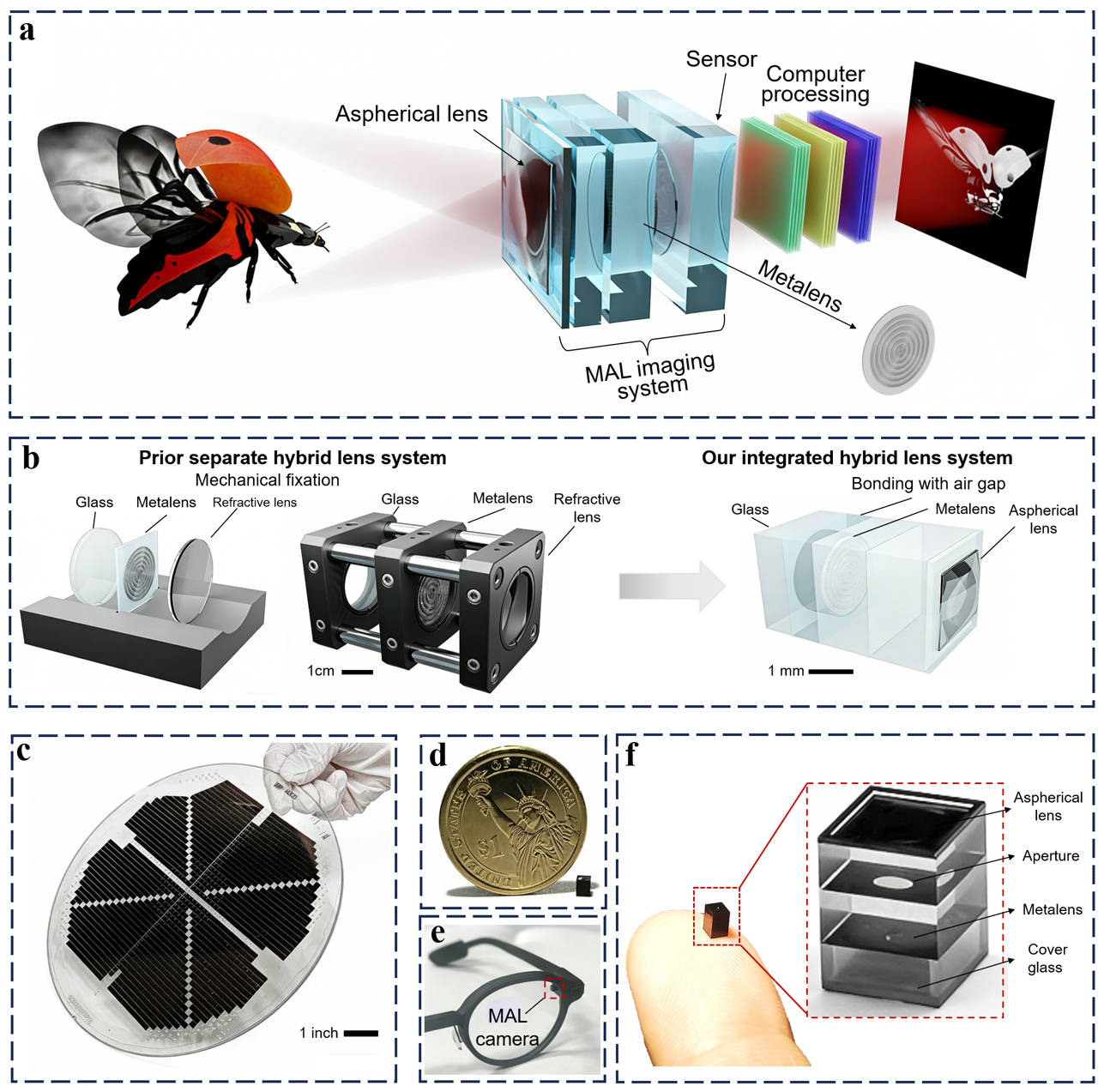
Schematic and demonstration of the meta-aspheric lens
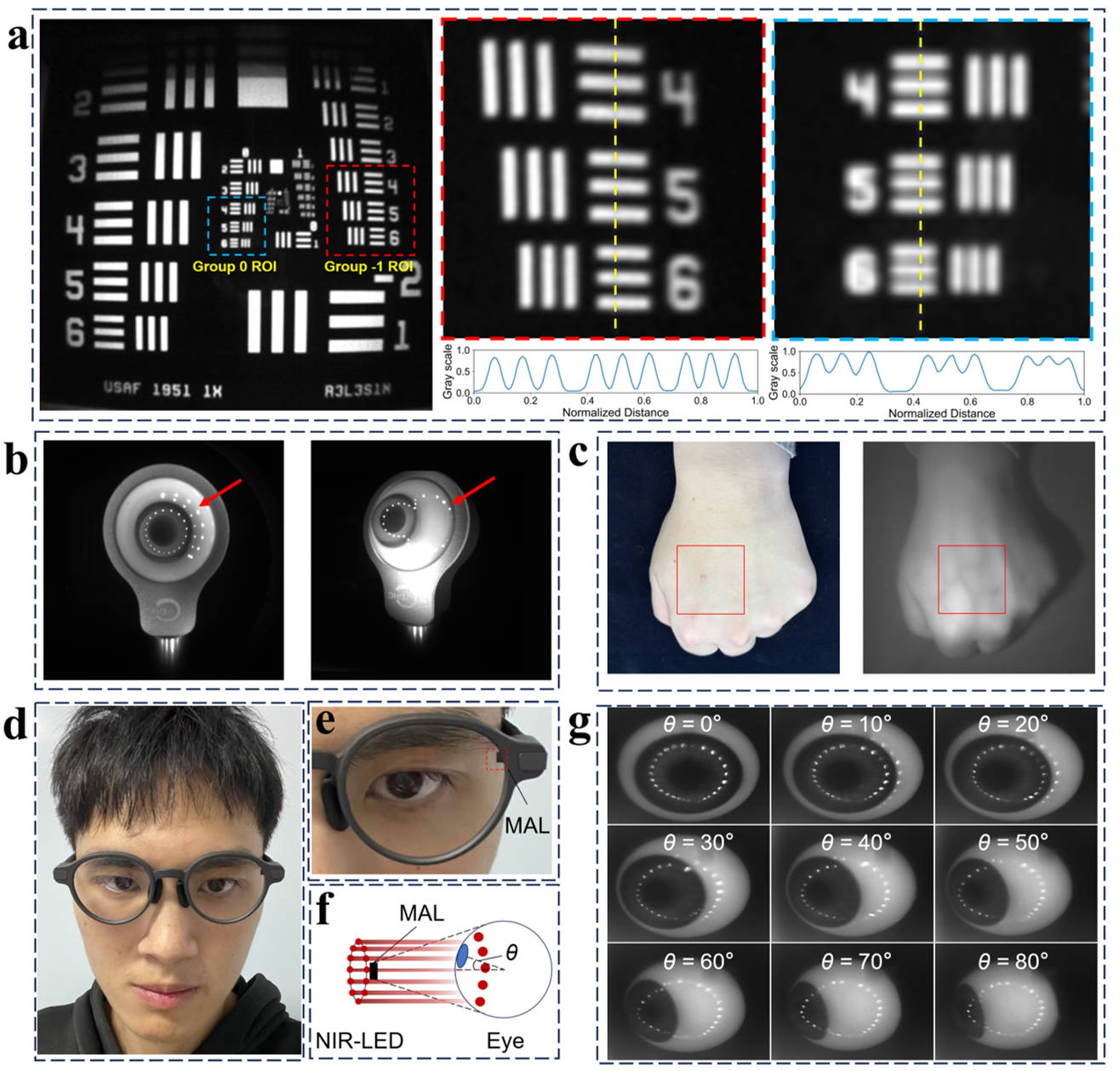
Imaging experiments and applications
GA, UNITED STATES, May 6, 2026 /EINPresswire.com/ -- Chinese scientists have developed an ultracompact near-infrared camera based on wafer-level manufactured meta-aspheric lens, simultaneously achieving 101.5° field-of-view, 3.39 mm thickness, and F/1.64 aperture within 0.02 cm³ volume. The fully integrated hybrid optics enables scalable mass production and opens doors for next-generation smartphones and AR glasses with advanced eye-tracking and biometric capabilities.
The rapid evolution of smartphone cameras and wearable augmented reality (AR) glasses is driving unprecedented demand for compact, high-performance imaging systems. Near-infrared imaging, essential for facial recognition, eye tracking, and medical diagnostics, supports deeper tissue penetration and improved low-light performance compared with visible-light modules. However, miniaturized near-infrared optical modules face a fundamental challenge: the long-standing trade-off between wide field-of-view, extreme compactness, and high imaging quality. Existing refractive optics cannot simultaneously support ultrawide angles above 100 degrees and ultrathin total track lengths below 5 mm, fundamentally limiting their integration into portable devices.
In a new paper published in Light: Advanced Manufacturing, a team of scientists led by Researcher Qiang Song from the Greater Bay Area Institute for Innovation, Hunan University, Professor Huigao Duan from the College of Mechanical and Vehicle Engineering, Hunan University, in collaboration with Goertek Omnilights NanoOptics Co., Ltd. (formerly Sunny Optical Olightek), have presented a wafer-level-manufactured meta-aspheric lens that achieves simultaneous wide field-of-view, ultrathin form factor, and high imaging quality. Professor Xin Yuan from Westlake University also made important contributions to this work. Unlike previous hybrid systems relying on separate refractive and diffractive components with mechanical fixation, their fully integrated architecture bonds aspherical lens and metalens at the wafer level, achieving micrometer-level precision without auxiliary hardware. This design compresses the volume to cubic-millimeter scale while maintaining excellent optical performance.
The meta-aspheric lens simultaneously achieves a 101.5° field-of-view, 3.39 mm total track length, and F/1.64 aperture within a compact volume of 0.02 cm³. The wafer-level manufacturing process enables high-throughput production: thousands of devices can be fabricated simultaneously on an 8-inch wafer, requiring only one dicing step. The design incorporates manufacturability from the outset, using experimentally validated dispersion models to ensure experimental performance matches simulation results.
These scientists validated their approach through both direct and computational imaging experiments. The camera demonstrated robust near-infrared imaging performance in eye tracking, blood vessel imaging, and computational pixel super-resolution tasks. When integrated into AR glasses, the ultracompact form factor enabled seamless deployment without compromising aesthetic design or user experience, capturing complete eye contours and corneal reflections across 0°–80° viewing angles for precise gaze detection.
The scientists summarize the innovation of their work: "We introduce a co-design strategy that fully integrates the metasurface and aspherical lens from the beginning as a single optical entity, enabled by our new concept of 'design for hybrid manufacturability.' This moves beyond component-level innovation to introduce a system-level methodology unifying optical design and mass manufacturing, closing the gap between laboratory demonstrations and scalable commercialization."
"This technology establishes a new benchmark for high-performance miniaturized near-infrared imaging," they added. "It opens the door for next-generation smartphones and AR optical systems, with strong potential for applications in biometric authentication, medical imaging, and human-device interactive interfaces."
Original Source URL
https://doi.org/10.37188/lam.2026.045
Funding information
This work was funded by the National Key R&D Program of China (2022YFB4602600 and 2024YFF05603), National Natural Science Foundation of China (Grant Nos. 52425508, 52221001, and 62271414), and the Key R&D Program of Hunan Province (2025JK2009). The authors thank Goertek Omnilights NanoOptics Co., Ltd. for financial and technical support.
Lucy Wang
BioDesign Research
email us here
Legal Disclaimer:
EIN Presswire provides this news content "as is" without warranty of any kind. We do not accept any responsibility or liability for the accuracy, content, images, videos, licenses, completeness, legality, or reliability of the information contained in this article. If you have any complaints or copyright issues related to this article, kindly contact the author above.
