

Area Selection — Not Property Type — Explains 86% of Australian Property Growth, New Analysis Finds
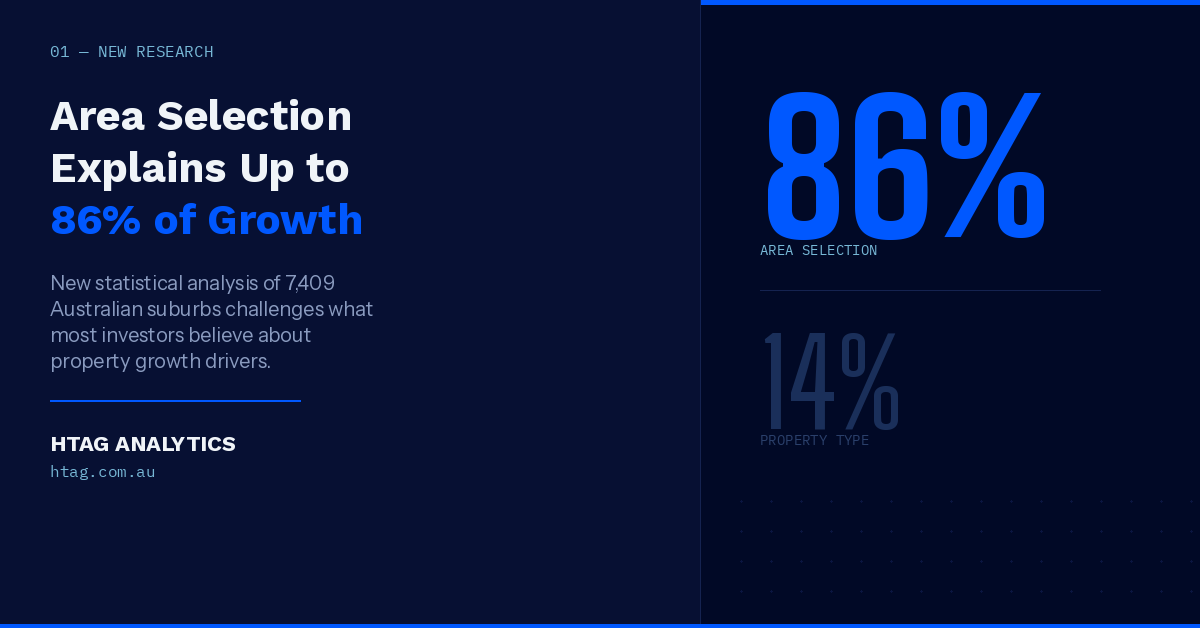
HTAG Analytics research reveals area selection explains up to 86% of property capital growth, with property type accounting for just 14% — based on analysis of 7,409 Australian suburbs.
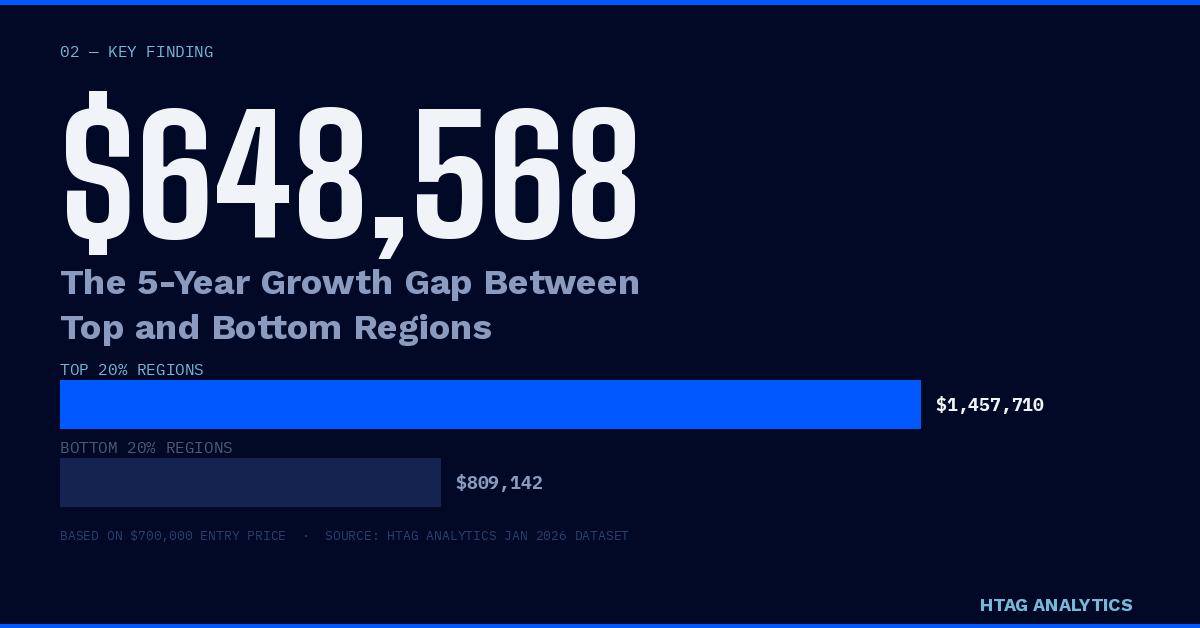
The five-year growth gap between top-performing and bottom-performing regions exceeds $648,000 on a $700,000 property, according to new HTAG Analytics research.
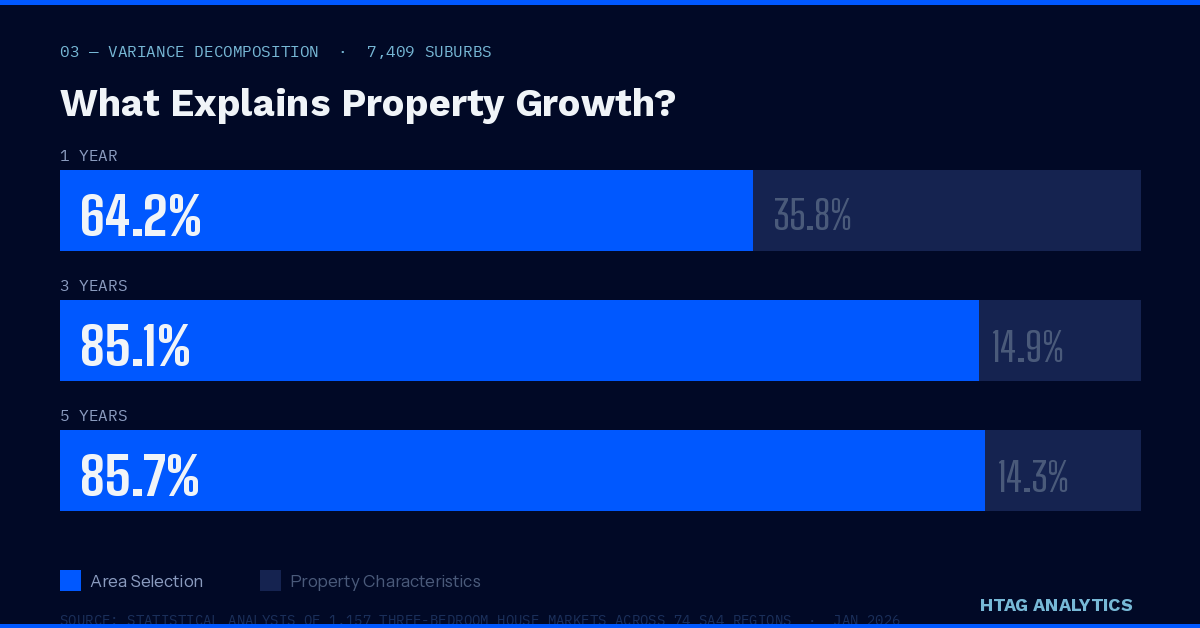
Variance decomposition analysis shows the dominance of area selection grows over time — from 64.2% at one year to 85.7% at five years across 1,157 three-bedroom house markets.
HTAG Analytics study of 7,409 suburbs shows $648,568 gap between top and bottom regions over five years on a $700K property
Data-science platform HTAG Analytics publishes peer-reviewed-backed research showing the gap between top- and bottom-performing regions exceeds $648,000 on a $700K property over five years.
A new statistical analysis released today by HTAG Analytics, an Australian property data-science platform, has found that the area in which an investor purchases a property explains up to 85.7% of capital growth outcomes over a five-year period. Property-level characteristics — including bedroom count, land size, and building age — account for just 14.3% of growth variation.
The research, based on a variance decomposition analysis of 7,409 suburb-level records covering all Australian house markets, challenges the widely-held investor belief that sourcing a higher-specification property is the primary driver of wealth creation through real estate.
Key Findings
The analysis isolated 1,157 three-bedroom house markets across 74 SA4 statistical regions and measured the proportion of price growth variance attributable to regional factors versus property-specific factors. The findings were consistent across all timeframes tested:
Time Horizon Explained by Area Explained by Property
1 Year 64.2% 35.8%
3 Years 85.1% 14.9%
5 Years 85.7% 14.3%
Applied to a $700,000 entry-level investment, the research found that properties in top-performing regions (top 20%) grew to $1,457,710 over five years, compared to $809,142 in bottom-performing regions — a gap of $648,568, equivalent to nearly the entire original purchase price.
Higher Price Does Not Mean Higher Growth
The research also revealed a negative correlation between property price and capital growth across all timeframes tested (r = −0.350 at one year; r = −0.322 at five years), indicating that more expensive properties tend to deliver lower percentage returns. This finding is consistent with international academic literature, including Kou (2019), who found that lower-priced properties in well-positioned areas exhibited higher appreciation potential in a study of over 21,000 properties.
Commentary
“The data is unambiguous: where you buy matters far more than what you buy. In top-growth areas, every month on the sidelines costs approximately $9,000 in foregone equity on a $700,000 property.”
— Dr. Mat Djolic, Founder, HTAG Analytics
Supported by Peer-Reviewed Research
The findings are corroborated by five peer-reviewed academic studies spanning multiple countries and methodologies, including Morano et al. (2019), who found that area quality can shift property values by up to 143% of base value for structurally identical homes, and Higgins & Kanaroglou (2019), whose meta-analysis of 52 studies across 654,762 properties confirmed that location factors consistently outweigh asset-level attributes in determining property values.
Methodology
The analysis used variance decomposition techniques across 7,409 suburb-level records from the January 2026 dataset, covering all Australian house markets. Three-bedroom house markets (1,157 records across 74 SA4 regions) were isolated to control for property type. Growth variance was decomposed into between-region and within-region components across one-year, three-year, and five-year timeframes. Correlation analysis was performed between median prices and growth rates across all timeframes.
Availability
The full research paper, including detailed data tables, opportunity cost modelling, and complete academic references, has been published to HTAG Analytics’ professional subscriber base. Buyers agents and property professionals can access the research and HTAG’s data analytics platform at htag.com.au.
###
About HTAG Analytics
HTAG Analytics is an Australian property data-science platform that provides institutional-grade market intelligence to property investors and buyers agents. Using proprietary scoring methodologies including socio-economic analysis (IRSAD), cyclical momentum tracking, and supply-demand modelling, HTAG helps professionals identify high-growth suburbs and make evidence-based investment decisions. The platform serves both individual investors and a growing professional subscriber community of buyers agents across Australia.
Media Contact
Dr. Mat Djolic
Founder, HTAG Analytics
Email: admin@htag.com.au
Website: htag.com.au
Mat Djolic
HtAG Analytics
email us here
Visit us on social media:
LinkedIn
Instagram
Facebook
YouTube
TikTok
X
Legal Disclaimer:
EIN Presswire provides this news content "as is" without warranty of any kind. We do not accept any responsibility or liability for the accuracy, content, images, videos, licenses, completeness, legality, or reliability of the information contained in this article. If you have any complaints or copyright issues related to this article, kindly contact the author above.
