

Point-to-Multipoint Microwave Backhaul Market, Enabling High-Capacity 5G and Rural Connectivity Worldwide
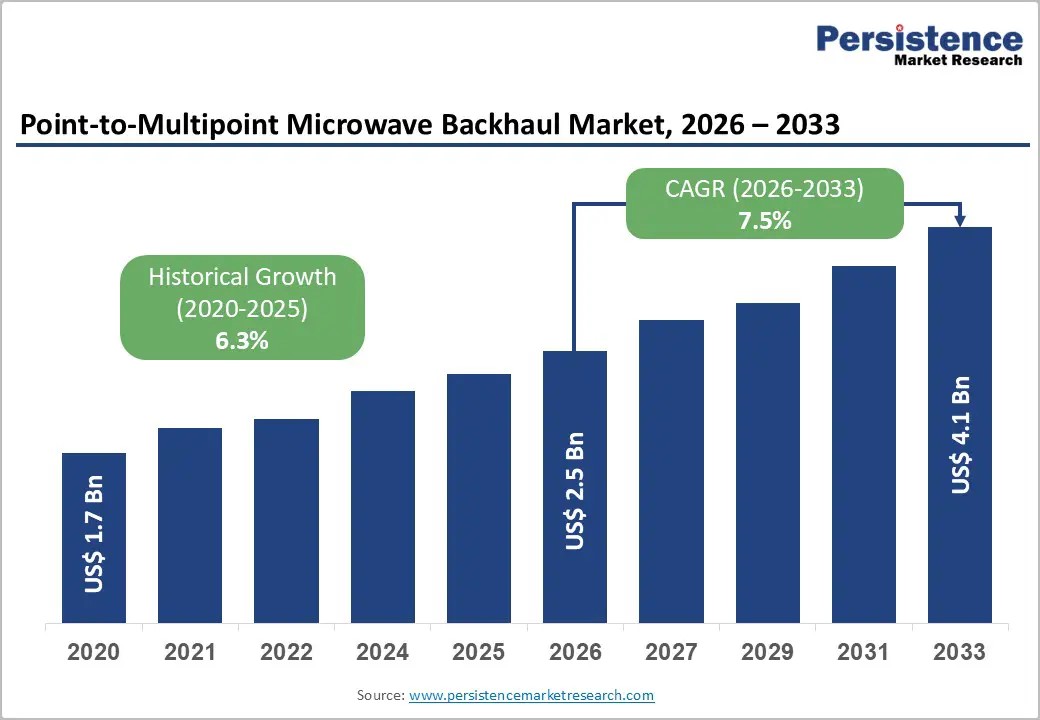
Global point-to-multipoint microwave backhaul market to grow from US$2.5 Bn in 2026 to US$4.1 Bn by 2033, registering a 7.5% CAGR driven by 5G network expansion
BRENTFORD, ENGLAND, UNITED KINGDOM, February 26, 2026 /EINPresswire.com/ -- Market Overview and Growth Outlook
The global Point-to-Multipoint Microwave Backhaul Market was valued at US$ 2.5 billion in 2026 and is projected to reach US$ 4.1 billion by 2033, expanding at a CAGR of 7.5% during the forecast period. This steady growth reflects the rising need for cost-efficient wireless backhaul solutions as telecom operators accelerate 5G network densification and small-cell deployments. Compared to the historical CAGR of 6.3% between 2020 and 2025, the market is entering a more dynamic expansion phase driven by higher data consumption and spectrum innovations.
Key growth drivers include the rapid rollout of 5G infrastructure, increasing enterprise private network deployments, and the need for scalable alternatives to expensive fiber backhaul installations. The telecom operators segment dominates end-user adoption due to extensive rural connectivity projects and urban small-cell aggregation requirements. Geographically, North America leads with a 28% market share, supported by mature 5G infrastructure, strong regulatory backing for E-band and millimeter-wave spectrum, and large-scale network modernization initiatives.
𝐆𝐞𝐭 𝐚 𝐒𝐚𝐦𝐩𝐥𝐞 𝐏𝐃𝐅 𝐁𝐫𝐨𝐜𝐡𝐮𝐫𝐞 𝐨𝐟 𝐭𝐡𝐞 𝐑𝐞𝐩𝐨𝐫𝐭: https://www.persistencemarketresearch.com/samples/4691
Key Highlights from the Report
North America accounts for 28% of the global market due to advanced 5G deployments and favorable spectrum policies.
Traditional microwave frequencies (6–42 GHz) hold a dominant 48.3% market share owing to proven reliability and regulatory familiarity.
East Asia represents the fastest-growing regional market, supported by aggressive 5G expansion and telecom densification.
E-band and V-band technologies are the fastest-growing segments for ultra-high-capacity urban backhaul.
Telecom operators remain the largest end-user segment, leveraging microwave backhaul for rural and urban connectivity.
The market is projected to grow from US$ 2.5 billion in 2026 to US$ 4.1 billion by 2033 at a CAGR of 7.5%.
Market Segmentation Analysis
The Point-to-Multipoint Microwave Backhaul Market is segmented primarily by frequency band, technology type, and end-user. By frequency band, traditional microwave frequencies (6–42 GHz) continue to dominate due to their deployment maturity, cost-effectiveness, and regulatory stability. These bands are widely used in rural backhaul networks and semi-urban deployments where moderate capacity and extended reach are required.
Meanwhile, E-band (70/80 GHz) and V-band millimeter-wave frequencies are gaining momentum as the fastest-growing technology segments. These high-frequency bands enable ultra-high-capacity backhaul with low latency, making them ideal for dense metropolitan 5G small-cell networks. In terms of end-users, telecom operators represent the largest segment, followed by enterprises deploying private LTE and 5G networks for Industry 4.0, smart manufacturing, and campus connectivity.
Regional Insights
North America holds the largest share of the global market, driven by widespread 5G rollout, strong adoption of millimeter-wave spectrum, and regulatory support for dynamic spectrum access. The region’s dense urban infrastructure and early adoption of small-cell networks significantly boost demand for point-to-multipoint microwave backhaul systems.
East Asia accounts for approximately 26% of the global market and is the fastest-growing region. Rapid 5G expansion in China, increasing telecom densification in India, and advanced network technology adoption in Japan are fueling strong regional growth. Europe follows with a 22% share, supported by rural broadband initiatives and Industry 4.0 adoption across industrial sectors.
𝐃𝐨 𝐘𝐨𝐮 𝐇𝐚𝐯𝐞 𝐀𝐧𝐲 𝐐𝐮𝐞𝐫𝐲 𝐎𝐫 𝐒𝐩𝐞𝐜𝐢𝐟𝐢𝐜 𝐑𝐞𝐪𝐮𝐢𝐫𝐞𝐦𝐞𝐧𝐭? 𝐑𝐞𝐪𝐮𝐞𝐬𝐭 𝐂𝐮𝐬𝐭𝐨𝐦𝐢𝐳𝐚𝐭𝐢𝐨𝐧 𝐨𝐟 𝐑𝐞𝐩𝐨𝐫𝐭: https://www.persistencemarketresearch.com/request-customization/4691
Market Drivers
The primary driver of the Point-to-Multipoint Microwave Backhaul Market is the accelerating densification of 5G networks. As telecom operators deploy thousands of small cells in urban environments, scalable and cost-effective backhaul solutions become essential. Microwave backhaul provides faster deployment timelines compared to fiber and significantly reduces capital expenditure.
Another major growth catalyst is the rising demand for enterprise private networks. Industries adopting smart manufacturing, IoT-based monitoring, and mission-critical communications require reliable and secure wireless backhaul infrastructure. Carrier aggregation advancements and multi-band radio technologies further enhance capacity and spectral efficiency.
Market Restraints
Despite strong growth potential, the market faces challenges related to spectrum congestion and regulatory complexity. Limited spectrum availability in certain regions can restrict deployment flexibility, particularly in densely populated urban areas. Licensing procedures and compliance requirements may delay project timelines.
Additionally, fiber backhaul remains a competitive alternative in urban centers where fiber infrastructure is already established. In high-traffic metro areas, operators may prefer fiber for long-term scalability, limiting microwave backhaul penetration in select markets.
Market Opportunities
Significant opportunities lie in rural broadband expansion initiatives and government-led connectivity programs. Many developing economies are prioritizing universal internet access, creating demand for cost-efficient wireless backhaul systems that bypass expensive fiber deployment.
The emergence of 6G research, advanced spectrum sharing models, and dynamic spectrum access frameworks presents long-term growth prospects. Innovations in multi-band radios and software-defined networking (SDN)-enabled microwave systems are expected to enhance network flexibility and drive next-generation backhaul adoption.
Company Insights
Key players operating in the global Point-to-Multipoint Microwave Backhaul Market include:
Ericsson
Nokia
Huawei Technologies Co., Ltd.
ZTE Corporation
Ceragon Networks Ltd.
Cambium Networks
Aviat Networks
Siklu Communication Ltd.
NEC Corporation
DragonWave-X
Recent Developments:
Ericsson introduced enhanced multi-band microwave solutions integrating E-band and traditional microwave frequencies for improved urban small-cell aggregation.
Ceragon Networks expanded its E-band portfolio to support higher-capacity 5G backhaul deployments in emerging markets.
𝐁𝐮𝐲 𝐍𝐨𝐰 𝐭𝐡𝐞 𝐃𝐞𝐭𝐚𝐢𝐥𝐞𝐝 𝐑𝐞𝐩𝐨𝐫𝐭: https://www.persistencemarketresearch.com/checkout/4691
Reasons to Buy the Report
✔ Gain comprehensive insights into market size, trends, and forecast through 2033.
✔ Identify high-growth segments such as E-band and millimeter-wave technologies.
✔ Understand regional market dynamics and competitive positioning.
✔ Analyze strategic developments and technological advancements shaping the industry.
✔ Make informed investment decisions with detailed segmentation and growth analysis.
Conclusion
The Point-to-Multipoint Microwave Backhaul Market is positioned for sustained growth as telecom operators and enterprises seek scalable, high-capacity, and cost-effective backhaul solutions. The combination of 5G network densification, expanding enterprise private networks, and supportive regulatory reforms ensures long-term market momentum.
With North America leading, East Asia accelerating rapidly, and Europe maintaining strong adoption, the global industry landscape remains highly competitive and innovation-driven. As spectrum technologies evolve and next-generation connectivity demands intensify, point-to-multipoint microwave backhaul solutions will continue to play a critical role in global digital infrastructure transformation.
Related Reports:
File Integrity Monitoring Market
Field Service Management Market
Pooja Gawai
Persistence Market Research
+1 646-878-6329
email us here
Visit us on social media:
LinkedIn
Instagram
Facebook
YouTube
Legal Disclaimer:
EIN Presswire provides this news content "as is" without warranty of any kind. We do not accept any responsibility or liability for the accuracy, content, images, videos, licenses, completeness, legality, or reliability of the information contained in this article. If you have any complaints or copyright issues related to this article, kindly contact the author above.
