

PLA-PHA Co-Polyester Fibers Market Valuation, ROI Potential & Long-Term Growth Prospects 2026–2036
PLA-PHA Co-Polyester Fibers Market
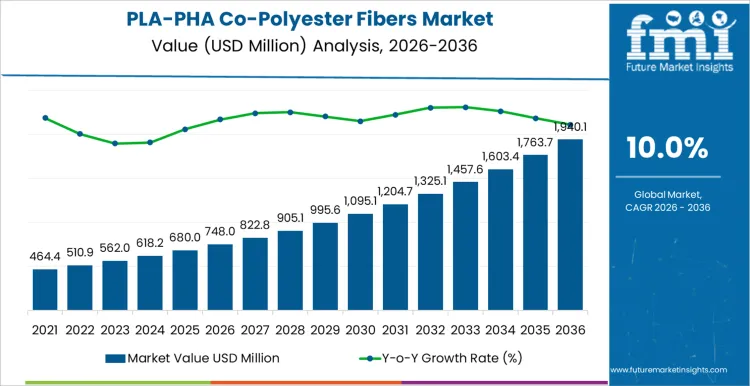
MD, UNITED STATES, January 20, 2026 /EINPresswire.com/ -- Future Market Insights (FMI), a leading provider of market intelligence and consulting services, today released its latest report on the global PLA-PHA Co-Polyester Fibers Market. The analysis projects the market to grow from USD 748.0 million in 2026 to USD 1,940.1 million by 2036, registering a compound annual growth rate (CAGR) of 10.0%. This growth reflects increasing adoption of biodegradable and compostable fibers in sectors such as hygiene, packaging, and technical textiles, driven by sustainability demands and advancements in bio-based polymer blends.
The report examines co-polyester fibers that integrate polylactic acid (PLA) and polyhydroxyalkanoate (PHA), materials known for their compostability, mechanical performance, and compatibility with existing manufacturing processes. These fibers are gaining traction in applications requiring predictable degradation and structural integrity, addressing environmental concerns over conventional polyesters. FMI's study provides detailed insights into market dynamics, segmentation, regional variations, and competitive strategies, offering stakeholders a data-driven foundation for decision-making.
Market Overview and Growth Projections
The PLA-PHA Co-Polyester Fibers Market encompasses bio-based fibers that combine PLA and PHA to deliver enhanced melt behavior, thermal stability, and mechanical retention. These properties make them suitable for nonwovens, yarns, and filaments in industries prioritizing end-of-life options like composting. Historical data from 2021 to 2025 indicates steady segment expansion, with the market poised for accelerated growth from 2026 onward.
Forecasts highlight a robust trajectory, with year-over-year (Y-o-Y) growth trends supporting the 10.0% CAGR through 2036. Absolute dollar opportunity analysis underscores potential in thicker fiber constructions and long-term supply agreements, enabling volume scaling in high-demand applications. This expansion is underpinned by the fibers' ability to integrate into melt spinning and bonding lines without major equipment modifications, facilitating broader industry adoption.
Key Market Segments: Blend Ratios, Applications, and Processing Routes
Segmentation by blend ratio reveals PLA-rich blends as the dominant category, capturing a 38.0% market share due to their superior dimensional control and draw stability. Balanced PLA-PHA and PHA-rich blends follow, offering flexibility for applications like bending and puncture-resistant structures. Other co-polyester systems round out the category, with historical and forecast values from 2021 to 2036 showing consistent Y-o-Y growth.
By application, hygiene and disposable textiles lead with a 30.0% share, emphasizing predictable web formation and cutting efficiency. Packaging and agriculture segments focus on flex life and resistance properties, while apparel and technical textiles benefit from drape and fatigue resistance. Additional uses include filtration and food service, with segmented forecasts indicating opportunities in consumer and personal care, industrial and agriculture, and other sectors.
Regional Insights: Asia Pacific Leads with Strong Growth in China
Geographically, the market spans Asia Pacific, Europe, North America, Latin America, and the Middle East & Africa, with detailed country-level analysis for key nations including the USA, China, Germany, Japan, and South Korea. China emerges as a frontrunner with an 11.2% CAGR, fueled by large-scale bio-based production and demand in packaging and hygiene. The USA follows at 9.7%, driven by compostable nonwovens, while Germany's 9.6% growth reflects emphasis on certified bio-based materials.
South Korea and Japan project CAGRs of 9.2% and 8.5%, respectively, supported by quality-focused manufacturing in hygiene and technical textiles. Other regions, such as Europe (including the UK, France, and Italy) and Latin America (Brazil and Mexico), show varying attractiveness based on material origin and disposal pathways. FMI's regional breakdown includes historical values, forecasts, and market share by segment, highlighting how local regulations and supply chains influence adoption.
Competitive Landscape: Key Players and Strategic Focus
The competitive environment features prominent companies such as NatureWorks, Danimer Scientific, TotalEnergies Corbion, Mitsubishi Chemical Group, Far Eastern New Century, Indorama Ventures, Toray Industries, Teijin, Sukano, and Biome Bioplastics. These players differentiate through biodegradability, processing stability, and sustainability compliance, with strategies centered on traceable bio-content, technical services, and high-performance applications.
Market structure analysis includes a competition dashboard, benchmarking, and share distribution by region, blend ratio, application, and end sector. Recent developments emphasize grade segmentation by melt point and modulus, feedstock agreements for supply continuity, and technical support for converter workflows. This positions the market for synchronized product introductions and multi-site deployments.
Request for Sample Report | Customize Report |purchase Full Report -https://www.futuremarketinsights.com/reports/sample/rep-gb-31596
Drivers, Restraints, Opportunities, and Emerging Trends
Key drivers include the demand for fibers with controlled degradation and mechanical predictability, alongside compatibility with existing production lines. Restraints involve higher raw material costs compared to conventional polyesters and process integration challenges, such as adjustments in melt temperature and draw ratios, which extend qualification cycles.
Opportunities lie in expanding fiber content in structures, growth in hygiene and filtration with defined disposal pathways, and forward purchase agreements to stabilize pricing. Trends point to a shift toward compostable polymer feedstocks, biodegradable filaments, and industrial compostability certifications, with a focus on lot traceability and substitution of traditional polyesters.
"These bio-based fibers represent a practical pathway for industries to meet sustainability goals without compromising performance," said an FMI analyst. "Our report provides the granular data needed to navigate this evolving market, from blend optimizations to regional supply strategies."
Explore More Related Studies Published by FMI Research:
Hydrocephalus Shunt Market-https://www.futuremarketinsights.com/reports/hydrocephalus-shunt-market
Endoscopic Closure Systems Market-https://www.futuremarketinsights.com/reports/endoscopic-closure-systems-market
Mammalian Transient Protein Expression Market-https://www.futuremarketinsights.com/reports/mammalian-transient-protein-expression-market
Home Sleep Apnea Testing Market-https://www.futuremarketinsights.com/reports/home-sleep-apnea-testing-market
Lacrimal Devices Market-https://www.futuremarketinsights.com/reports/lacrimal-devices-market
About Future Market Insights (FMI)
Future Market Insights, Inc. (FMI) is an ESOMAR-certified, ISO 9001:2015 market research and consulting organization, trusted by Fortune 500 clients and global enterprises. With operations in the U.S., UK, India, and Dubai, FMI provides data-backed insights and strategic intelligence across 30+ industries and 1200 markets worldwide.
Why FMI: Decisions that Change Outcomes- https://www.futuremarketinsights.com/why-fmi
Contact Us:
Future Market Insights Inc.
Christiana Corporate, 200 Continental Drive,
Suite 401, Newark, Delaware – 19713, USA
T: +1-347-918-3531
Website: https://www.futuremarketinsights.com
LinkedIn| Twitter| Blogs | YouTube
Have a specific Requirements and Need Assistant on Report Pricing or Limited Budget please contact us - sales@futuremarketinsights.com
Sudip Saha
Future Market Insights Inc.
+1 347-918-3531
email us here
Legal Disclaimer:
EIN Presswire provides this news content "as is" without warranty of any kind. We do not accept any responsibility or liability for the accuracy, content, images, videos, licenses, completeness, legality, or reliability of the information contained in this article. If you have any complaints or copyright issues related to this article, kindly contact the author above.
